

All Content
Welcome to the Institute for the Study of States of Exception (ISSE) main content page, a single source for all posts from the Institute, including commentary on global events, book reviews, academic literature, links to our podcasts, and additional resources. Check back regularly for more content from us.
“Sovereign is he who decides the exception.”
— Carl Schmitt (Political Theology: Four Chapters on the Concept of Sovereignty, 1922)

Digital Rights and the State of Exception. Internet Shutdowns from the Perspective of Just Securitization Theory
Using cross national cases, Johannes Thumfart discusses internet shutdowns (ISs) within the Just Securitization Theory (JST). Thumfart denies the legitimacy of the vast majority of ISs, while sketching four exception scenarios of ISs justification.

Bolivia Declares 90-Day State of Emergency Amid Nationwide Protests
On June 20, 2026, Bolivia declared a 90-day nationwide state of emergency after weeks of protests and road blockades disrupted fuel supplies, transportation, and access to essential services. ISSE examines the legal authorities invoked, the role of legislative oversight, and what the declaration reveals about how democratic governments use emergency powers during periods of prolonged political and economic crisis.

Managing conflict through civic participation: Taiwan’s civic-embedded diplomacy and the transformation of authority after martial law
Yung Lin argues that Taiwan's civic-embedded public diplomacy (CEPD) offers a distinct post-authoritarian model of conflict resolution in East Asia. The article shows how CEPD strengthens domestic legitimacy while managing identity-based conflict through the normalization of Taiwan's international visibility.

Democracy as a Security Asset - European Evidence Review
Drawing on more than three decades of comparative evidence, this report argues that democratic governance strengthens national security by reinforcing institutional resilience, public trust, accountability, and effective crisis response, challenging the assumption that security requires weaker democratic constraints. The report provides an evidence-based framework for understanding how constitutional guardrails and democratic oversight contribute to long-term security while helping prevent the normalization of extraordinary executive authority.

Why Is the Weaponization Report So… Normal? - Lawfare
Kate Gilbert examines how the Department of Justice’s report uses the language of ordinary bureaucracy to frame extraordinary political claims. The article raises questions central to ISSE’s work: how exceptional political logics become embedded within routine democratic governance and how expansive interpretations of Unitary Executive Theory may reshape democratic governance.

ISSE Explainer: When Executive Power Becomes Exceptional — Unitary Executive Theory as a State of Exception
How can the most expansive forms of the unitary executive theory function as a standing state of exception within constitutional law? ISSE puts the recent legal disputes over the revocation of security clearances and the attempted federalization of National Guard within a deeper theory of presidential power.

The Unitary Executive Theory in Comparative Contrast
Should the Supreme Court craft a new rule of constitutional law cementing presidential control over the executive branch of government? Using the case studies of recent democratic decline in Hungary, Poland, and Turkey, David M. Driesen unpacks the implications of expanding executive authority.
The Unitary Executive Theory with Mark Rozell - Bill of Rights Institute, Scholar Talks series
How has the use of presidential “czars” undermined Congress and the Constitution? Dr. Mark J. Rozell discusses his newest book “Unitary Executive Theory: A Danger to Constitutional Government.”

A Threat to the Constitutional Order - American Enterprise Institute
Examining the Supreme Court’s consideration of the Trump v. Slaughter case, Peter J. Wallison argues that permitting presidents to remove officials from independent regulatory agencies without a cause would fundamentally alter the balance between Congress and the executive branch. Relevant to ISSE’s work, Wallison warns that subtle judicial reinterpretations of constitutional structure over time accumulate excessive concentrations of executive power.

The Bound Executive: Emergency Powers During the Pandemic
Drawing on a comparative study of countries' responses to the COVID-19 pandemic, Tom Ginsburg and Mila Versteeg argue that courts, legislatures, and subnational governments remained important constraints on executive power during emergencies. The article develops a typology of crises to show that different emergencies require different modes of governance and concludes that many emergencies are better governed through Madisonian checks and balances than Schmittian executive dominance.

The Imaginary Unitary Executive - Lawfare
Contrary to the “Decision of 1789” myth, history shows that the first Congress rejected the exclusive unitary model of the presidency—and thus the presidential removal power should be subject to more congressional control than recent Supreme Court decisions have held.
The Unitary Executive: Past, Present, Future
Cass R. Sunstein and Adrian Vermeule examine the past, present, and future of the unitary executive theory, exploring competing constitutional interpretations of presidential control over the executive branch. The article analyzes the Supreme Court's treatment of the doctrine, particularly in Seila Law, and assesses its implications for presidential authority, independent agencies, and the separation of powers.

James Madison and the Emergency Powers of the Legislature
Prerogative, the power to take extra-legal measures in extraordinary circumstances, is generally considered to be the exclusive domain of the executive. This article shows that James Madison, who is widely regarded as hostile to discretionary power in the executive, not only endorsed exercises of prerogative by the executive but also took steps toward developing a model of prerogative that gives primacy to the legislature in times of emergency. Madison’s views on “legislative prerogative” emerged in the context of congressional debates over avowedly unconstitutional proposals including a grant of military authority to seize private property during the revolutionary war, the creation of the Bank of North America under the Articles of Confederation, and the provision of financial assistance to refugees from St. Domingo. These cases reveal a strict constructionist resorting to extra-legal measures to pursue objectives not expressly authorized by the constitution then in place as a safer alternative to more permanent expansions of government power established through law.
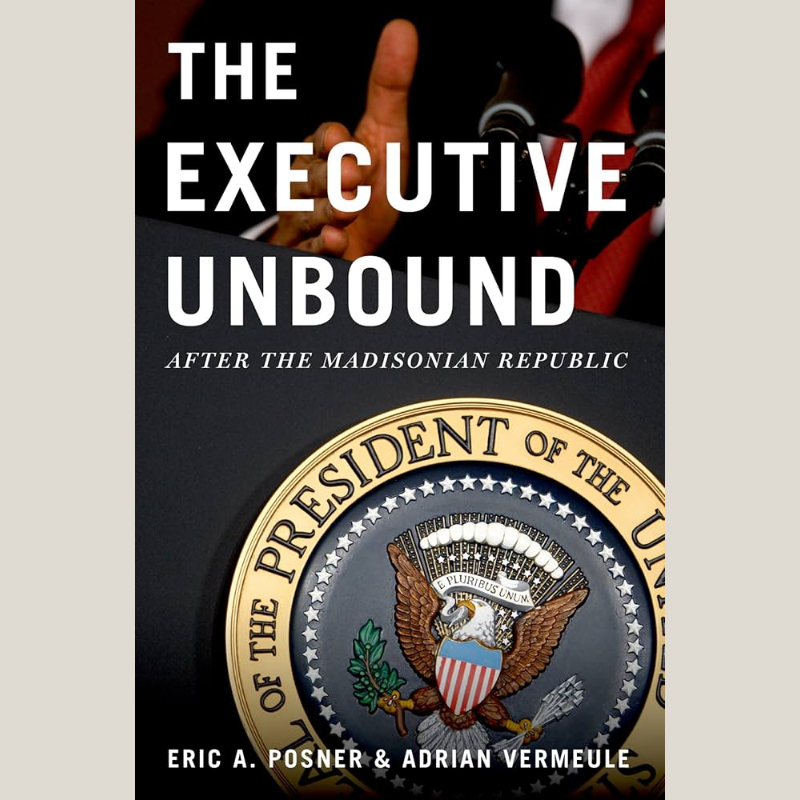
The Executive Unbound: After the Madisonian Republic
In this influential and controversial book, Eric Posner and Adrian Vermeule argue that the traditional Madisonian system of checks and balances has been largely superseded by an executive-centered form of governance in which political and public-opinion-based constraints matter more than formal legal limits. The authors contend that the complexity of modern government inevitably concentrates authority in the executive branch and that fears of excessive presidential power are often overstated. Particularly relevant to ISSE’s work, the book raises fundamental questions about executive authority, emergency governance, constitutional constraint, and whether the growth of executive power reflects a constitutional danger, a practical necessity, or an enduring feature of the modern state.
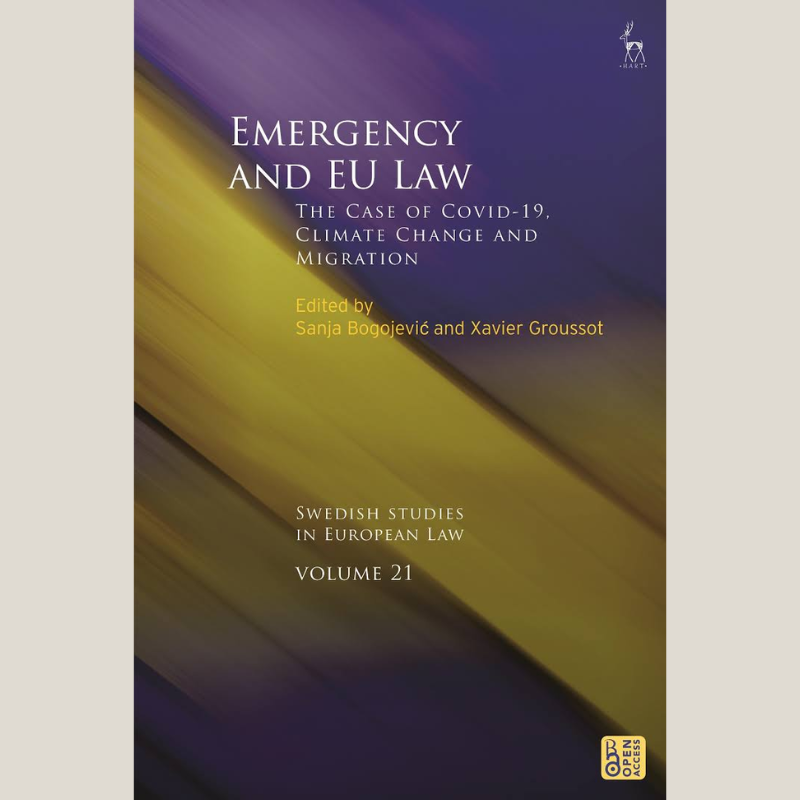
Emergency and EU Law: The Case of Covid-19, Climate Change and Migration
From the Book Preface: The concept for this edited volume emerged during a time when the world was gradually moving away from the emergency measures implemented in response to the Covid-19 pandemic. One of us spent much of the pandemic in the UK, while the other was in Sweden, each of us witnessing very different governmental responses. Having worked together in Lund during the 2015 European migration crisis that saw more than one million people seek asylum in Europe, this had not been our first encounter with emergency measures. During this period, Sweden imposed border controls and ID checks on the Öresund Bridge that connects Lund to Denmark and the rest of the European continent. Sweden was not alone in enacting emergency measures in the form of restrictions on movement within the Schengen Area – Denmark enforced similar measures at its border with Germany, and Germany did the same on its border with Austria. As EU law scholars, we were curious about the impact that emergencies have on the EU: a jurisdiction built on solidarity, free movement and the rule of law.
More precisely, we got to debating the question in which circumstances, if any, fundamental rights could legitimately be suspended in the face of an emergency. And if there were to be such a suspension, who should take responsibility for safeguarding that this exercise of power did not erode procedural and substantive fundamental rights: the EU or national courts, the EU or national parliaments, the public or a different body altogether? What role might proportionality play in balancing different rights in cases of emergency? Sitting in Sweden, which lacks formal constitutional provisions for declaring a state of emergency (except in the case of war), it quickly became apparent that a definition of what counts as an emergency is crucial: could it be that what is to be labelled an ‘emergency’ in one country is approached as a ‘crisis’ in another? What might be the legal implications of such divergencies? Even if we could rally around a common definition of what constitutes an emergency, should we approach the migration crises, the Covid-19 pandemic, and climate change the same way?

U.S. Judicial Power and the Normalization of Exceptionality - Louisiana v. Callais
The Supreme Court’s decision in Louisiana v. Callais has intensified debate over judicial power, electoral representation, and democratic legitimacy in the United States. While supporters view the ruling as a constitutional limit on race-conscious districting, critics argue it may weaken Black political representation in several Southern states. From an ISSE perspective, the case is significant not only for its voting-rights implications, but for how accelerated procedures and emergency-style mechanisms derived from the ruling are already shaping ordinary democratic governance. Rapid redistricting efforts and compressed legislative timelines illustrate how exceptional practices can become enabled and embedded within formally constitutional processes. The case raises broader questions about democratic resilience, institutional restraint, and the gradual normalization of exceptionality within contemporary governance.

Hungary: New Government Needs to Restore Rule of Law - Human Rights Watch
Human Rights Watch’s analysis of Hungary highlights how emergency powers have become embedded in the country’s political system. Under Viktor Orbán, who was voted out of office in April 2026, crisis-driven authorities have evolved into durable tools for governing, shaping media, institutions, and electoral competition. Rather than temporary measures, emergency frameworks have been renewed and repurposed across migration, pandemic, and security contexts. Weak domestic and external constraints have allowed these powers to persist with limited oversight. For ISSE, Hungary illustrates the normalization of exceptionality, where extraordinary powers become a routine feature of democratic governance.
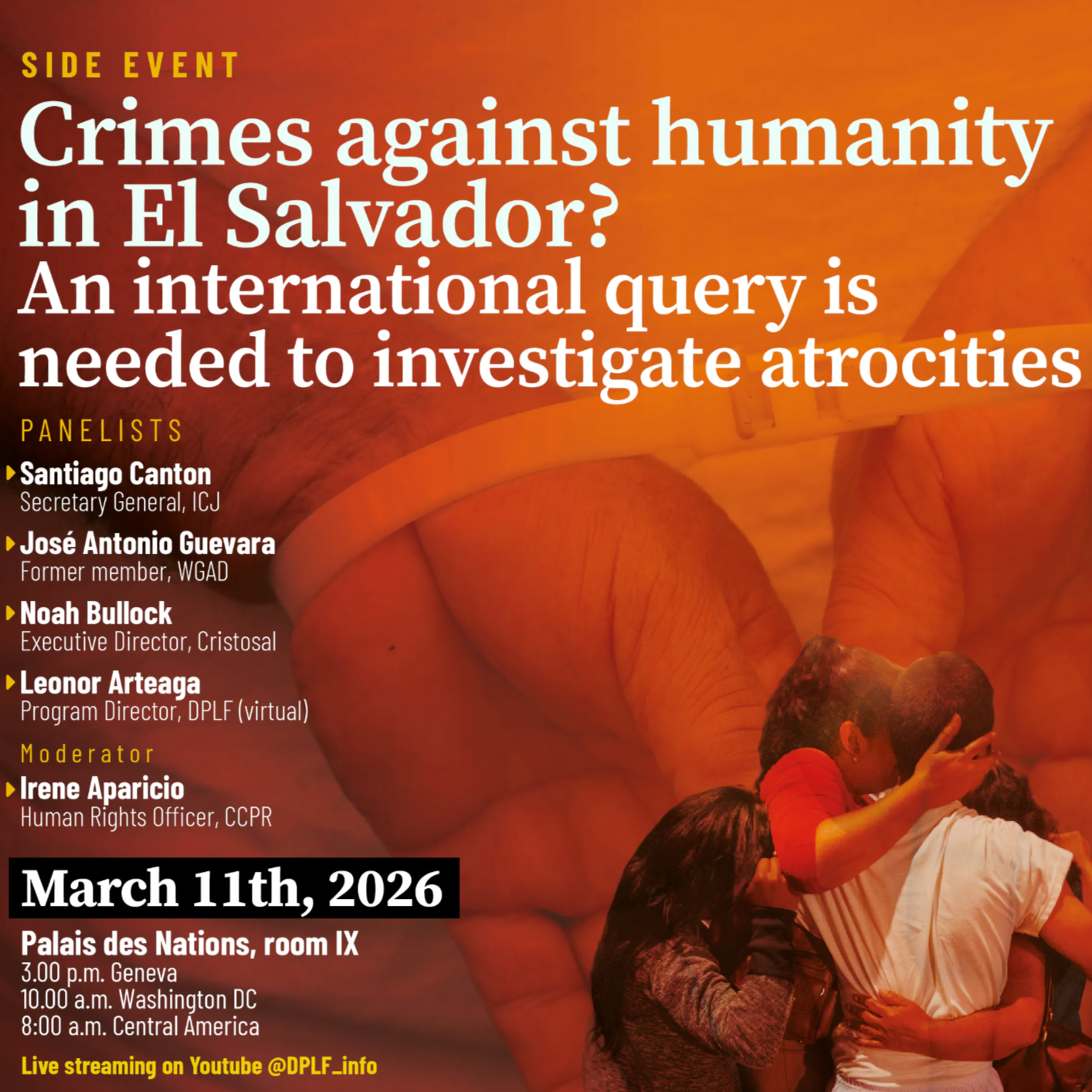
Crimes against humanity in El Salvador? An international query is needed to investigate atrocities - side event at March 11, 2026 UN Human Rights Council Session
Supported by civil society, a group of independent international law and human rights experts (The International Group of Experts for the Investigation of Human Rights Violations in the Context of the State of Emergency in El Salvador – GIPES [for its initials in Spanish]) was convened to investigate whether systematic abuses being carried out under the State of Exception public security policy in El Salvador –including torture, sexual violence, enforced disappearances, and extrajudicial executions– are indeed crimes against humanity.
On March 11, 2026, at a side event to the United Nations Human Rights Council session, members of the Group and civil society presented the Group of Experts initiative, their research findings and legal analysis, and other key information about the ongoing State of Exception and its impact in El Salvador.
The invited speakers were Leonor Arteaga, Program Director at DPLF; Santiago Canton, ICJ Director and GIPES member; José Antonio Guevara, former WGAD President and Group member; and Noah Bullock, the Executive Director of Cristosal. Irene Aparicio of CCPR moderated the panel discussion.
This side event was hosted by the Centre for Civil and Political Rights (CCPR), Cristosal, Due Process of Law Foundation (DPLF), InterJust, International Commission of Jurists (ICJ), International Federation for Human Rights (FIDH), Redress, Rights & Security International.
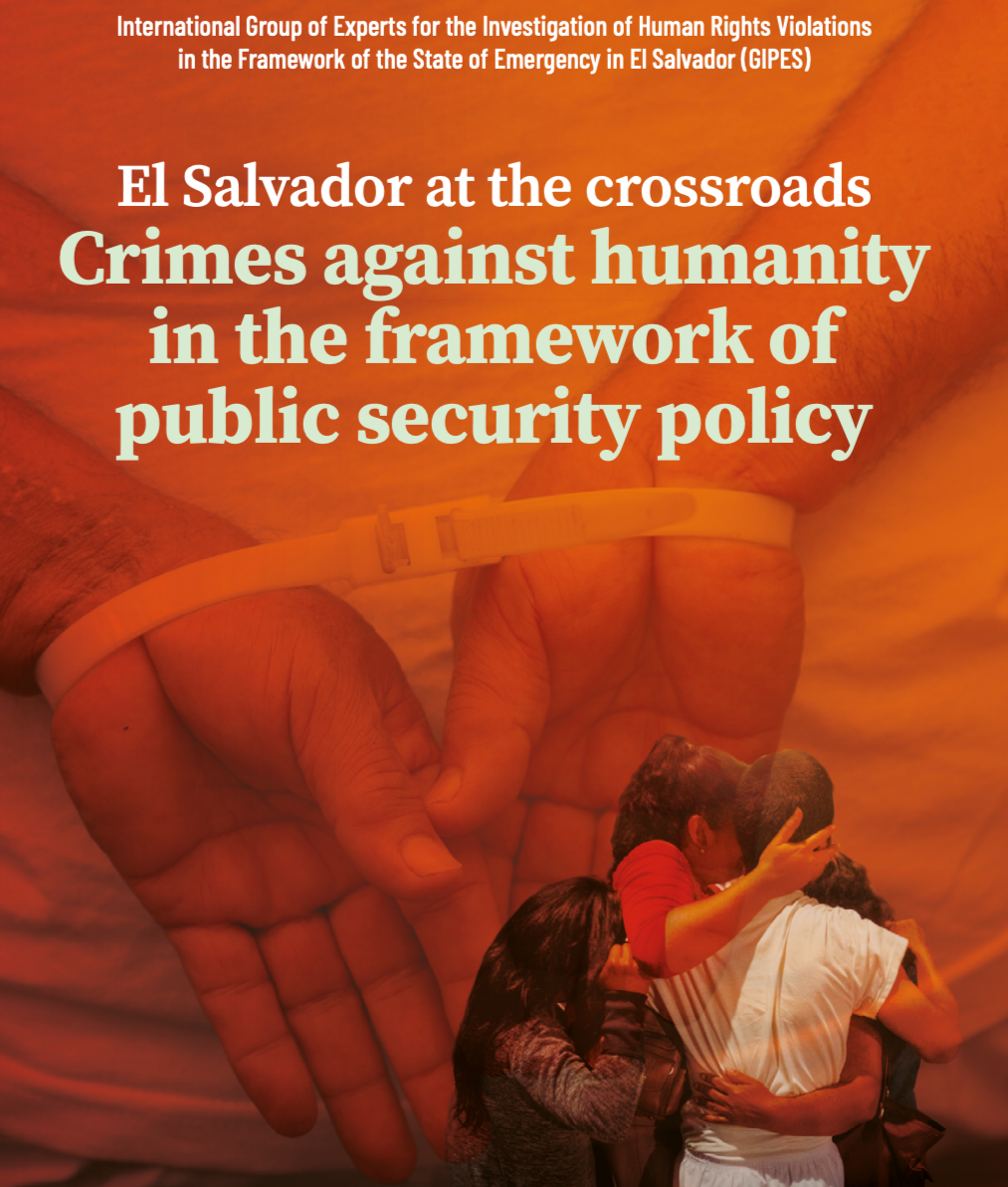
El Salvador at the Crossroads: Crimes against Humanity under the Public Security Policy - Due Process of Law Foundation, et al.
An international panel of legal experts has concluded that serious human rights violations committed under El Salvador’s ongoing state of emergency may constitute crimes against humanity. The report examines allegations including arbitrary detention, torture, enforced disappearances, sexual violence, and persecution carried out as part of the government’s security policy since March 2022. Beyond documenting abuses, the study argues that the prolonged state of exception has weakened democratic safeguards, eroded separation of powers, and concentrated authority within the executive branch. The report also calls for independent case review mechanisms and greater international accountability efforts. For ISSE, the findings highlight the long-term institutional risks posed by entrenched emergency governance.

European Journal of Risk Regulation - Special Issue on Constitutional Risk Management in the V4 Countries - Foreword
This Foreword introduces the special issue of the European Journal of Risk Regulation entitled “Constitutional Risk Management in the V4 Countries,” which examines how constitutional democracies respond to crises through emergency legal regimes and exceptional powers. Focusing on the Czech Republic, Hungary, Poland, and Slovakia, the issue explores the constitutional management of crises including the COVID-19 pandemic, war, migration, and environmental emergencies. The collection analyzes both the legal frameworks governing states of exception and the broader normative question of how democratic systems can preserve rule-of-law safeguards during prolonged crises. ISSE will publish each article from the special issue as standalone website entries in the coming weeks. All materials are Open Access and distributed under a Creative Commons Attribution license.