
The Executive Unbound: After the Madisonian Republic
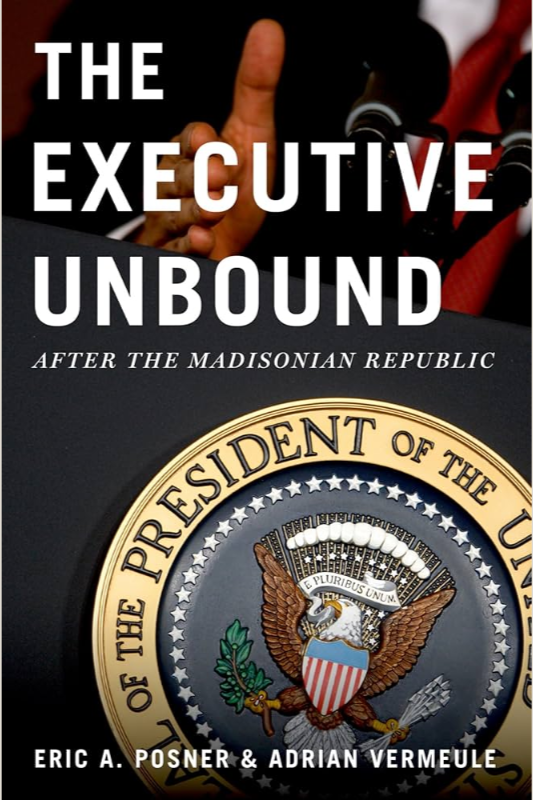
The Executive Unbound:
After the Madisonian Republic
Authors: Eric A. Posner and Adrian Vermeule. Posner is the Kirkland and Ellis Distinguished Service Professor of Law, University of Chicago. More on Posner can be found here and here. Vermeule is the Ralph S. Tyler, Jr. Professor of Constitutional Law at Harvard Law School. More on Vermeule can be found here and here.
Book Publisher: Oxford University Press
Date of Publication: June 16, 2011
Book Citation: Posner, E.; Vermeule, A. (2011) The Executive Unbound: After the Madisonian Republic, Oxford University Press. https://doi.org/10.4324/9781003490449
The Executive Unbound: After the Madisonian Republic can be purchased here or here.
Abstract: Ever since Arthur M. Schlesinger Jr. used “imperial presidency” as a book title, the term has become central to the debate about the balance of power in the U.S. government. Since the presidency of George W. Bush, when advocates of executive power gained ascendancy, the argument has blazed hotter than ever. Many argue that the Constitution itself is in grave danger. What is to be done? The answer, according to this book, is nothing. The book challenges conventional wisdom, arguing that a strong presidency is inevitable in the modern world. It is noted that most scholars object to today's level of executive power because it varies so dramatically from the vision of the framers of the Constitution. But the book finds fault with James Madison's premises. Like an ideal market, Madison's separation of powers has no central director, but it lacks the price system which gives an economy its structure; there is nothing in checks and balances that intrinsically generates order or promotes positive arrangements. In fact, the greater complexity of the modern world produces a concentration of power, particularly in the White House. The book charts the rise of executive authority, noting that among strong presidents only Richard Nixon has come in for severe criticism, leading to legislation which was designed to limit the presidency, yet which failed to do so. Political, cultural and social restraints, it is argued, have been more effective in preventing dictatorship than any law. The executive-centered state tends to generate political checks that substitute for the legal checks of the Madisonian constitution.
Three book reviews of The Executive Unbound: After the Madisonian Republic follow:
After the Rule of Law (John Samples, Law & Liberty, December 2011). In this review, John Samples examines Eric Posner and Adrian Vermeule’s The Executive Unbound and challenges its central claim that legal constraints on executive power have largely given way to political and public-opinion-based checks. While acknowledging the authors’ argument that modern governance inevitably concentrates authority in the executive branch, Samples contends that they understate the continuing importance of constitutional structures, congressional authority, and the rule of law, while overstating the inevitability of executive dominance. For readers interested in emergency governance and executive power, the review highlights a core debate at the heart of contemporary constitutional theory: whether the rise of a powerful executive reflects an unavoidable feature of modern government or a development that democratic institutions can and should resist. The full book review by Samples can be found here, or by using the link embedded within the title.
Review of The Executive Unbound: After the Madisonian Republic (Graham G. Dodds, Law and Politics Book Review, 2012). In this detailed review, political scientist Graham Dodds assesses Eric Posner and Adrian Vermeule’s argument that the Madisonian system of checks and balances has become largely obsolete and that strong executive governance is both inevitable and beneficial in the modern state. While acknowledging the authors’ diagnosis of the growing concentration of presidential power and the weakness of traditional institutional constraints, Dodds challenges their conclusion that constitutional limits should be accepted as ineffective and largely supplanted by political checks and public opinion. For readers interested in emergency governance and executive authority, the review highlights a fundamental debate at the center of constitutional theory: whether the expansion of executive power reflects an unavoidable adaptation to modern governance or a development that democratic institutions remain capable of resisting and reforming. The full book review by Dodds can found here, or by using the link embedded within the title.
Review of The Executive Unbound: After the Madisonian Republic (Benjamin Kleinerman, Lawfare, July 2011). In this review, Benjamin Kleinerman argues that Eric Posner and Adrian Vermeule mischaracterize both James Madison and the broader constitutional tradition by treating legal constraints on executive power as largely illusory while placing primary faith in political constraints and public opinion. Kleinerman contends that the American constitutional system was never premised on blind confidence in law alone, but rather on the interaction between law, institutions, and political ambition, all of which work together to resist the concentration of power. For readers interested in executive authority and constitutional governance, the review highlights a central critique of The Executive Unbound: that dismissing the practical significance of legal constraints risks weakening the very political and institutional forces that have historically served as the most effective checks on executive aggrandizement. The full book review from Kleinerman can be found here, or by using the link embedded within the title.
