

All Content
Welcome to the Institute for the Study of States of Exception (ISSE) main content page, a single source for all posts from the Institute, including commentary on global events, book reviews, academic literature, links to our podcasts, and additional resources. Check back regularly for more content from us.
“Sovereign is he who decides the exception.”
— Carl Schmitt (Political Theology: Four Chapters on the Concept of Sovereignty, 1922)

Governance of emergency powers and accountability in Indonesian disaster management
This paper argues that disaster management governance in Indonesia must align with emergency principles. In emergencies, special laws apply to prevent budget misuse and abuse of power. This study analyzes emergency authority in Indonesia's checks and balances system, focusing on legislative oversight. Using a legal-normative approach, it reviews Law No. 24/2007 on Disaster Management and the principles of necessity, proportionality, and temporality. The main findings are: (1) national and regional legislatures have little role in extending or ending emergency status, which allows unchecked use of emergency powers; (2) oversight of emergency actions is weak; and (3) there are no clear time limits for emergencies, enabling excessive extensions. The study recommends reforming laws to: (a) increase the legislature’s role in emergency status decisions; (b) clarify oversight and budgeting authority; and (c) set deadlines and rules for extending emergencies to improve accountability.
EU Crises and Emergencies: What’s in a Name? - EmergEU Working Paper Series 1/2025
This workshop brought together scholars of law, political science, and related disciplines to interrogate how the European Union (EU) defines, governs, and is transformed by crises and emergencies. Against the backdrop of the Eurozone crisis, the migration crisis, the COVID-19 pandemic, and Russia’s war in Ukraine, the EU has increasingly been confronted with extraordinary events that test its constitutional foundations, governance mechanisms, and legitimacy. Yet despite the relevance of these events in the institutional and academic discourse, there remains no settled understanding of what qualifies as a ‘crisis’ or ‘emergency’, nor of how such labels shape institutional responses and longer-term integration trajectories.
The workshop opened with a keynote lecture by Professor Bruno de Witte (Maastricht University), who situated the debate in the broader legal context of EU emergency law. He underlined that, unlike many national systems, the EU Treaties provide no general emergency clause. Instead, the Union has relied on a scattered set of emergency competences and flexible interpretations of ordinary Treaty bases. In his view, emergency responses have demonstrated the EU’s capacity to adapt within the constraints of its legal order. This framing provided a point of reference for the four panels that followed, which explored how crises and emergencies are conceptualised, how they reshape governance structures, and how they are navigated in conditions of uncertainty.
The first explored the definitional boundaries of ‘crisis’ and ‘emergency’, revealing both disciplinary divergences and shared efforts to construct conceptual frameworks. The second examined how crises have reshaped the EU’s internal structures and external orientation, highlighting tensions between security, autonomy, and democratic legitimacy. The third turned to multilevel governance and emergency powers, tracing how regulation, financial autonomy, procurement mechanisms, and tacit states of exception transform the EU’s constitutional order. Finally, the fourth panel brought an epistemic perspective, foregrounding the role of institutions, individuals, and knowledge in navigating uncertainty.
State of Emergency, with Dr. Maciej Wilmanowicz - the first episode of a two part interview on the Common Sense Generation video podcast series
On the first episode of this two part interview on the Common Sense Generation video podcast series, Dr. Maciej Wilmanowicz introduces himself, describing himself as an intellectual historian rather than a philosopher by training. He discusses the historical roots of emergency powers going as far back as the Roman Republic, he analyzes the paradox of legalizing emergency powers, and he introduces the possibility of existing within a “permanent state of exception.”

Permanent State of Exception, with Dr. Maciej Wilmanowicz - the second episode of a two part interview on the Common Sense Generation video podcast series
On the second episode of this two part interview on the Common Sense Generation video podcast series, Dr. Maciej Wilmanowicz discusses philosopher Giorgio Agamben's concept that modern societies exist in a "permanent state of exception" - where emergency measures and exceptional legal frameworks have become normalized rather than temporary.
He goes on to discuss citizens’ responses to emergencies utilizing several contemporary examples, the challenge of the continuous expansion of related laws and regulations that no one can fully comprehend or navigate, how competing definitions of the “common good“ introduce coherence challenges, and several specific examples are provided which illuminate that final point, running the risk of undermining the very freedoms these powers are meant to protect.
The colonial origins of the ‘permanent state of exception’
During times of crisis, states have historically drawn upon ‘exceptional’ or emergency powers in order to govern. These typically involve the assumption of new kinds of dictatorial authority, the curtailment of basic civil rights, and a blurring of the ordinary distinctions between executive, legislative, and judicial forms of power.
Once the crisis has passed, states are meant to surrender these extraordinary powers, and return to a state of normalcy. But what if this state of affairs ceases to be temporary, and instead becomes a permanent feature of how governments operate?
Giorgio Agamben traces the origins of this permanent state of exception to the First World War, which saw an unprecedented number of countries around the world declare states of emergency or siege in order to manage the crises presented by a modern, industrial total war. For Agamben, the First World War opened up the possibility for a radically new form of state power that was fundamentally anti-democratic, authoritarian, and which operated through the mechanisms of a permanent state of emergency.
Agamben’s work is inherently Eurocentric, but if we turn our gaze beyond Europe to the imperial world a very different picture emerges. The unequal nature of European colonial power, premised on racial difference, rendered colonialism an inherently authoritarian and anti-democratic enterprise from the outset. Emergency was thus not something merely episodic or interruptive, but was a ‘technique of governance’ embedded into the everyday functioning of colonial regimes.

ISSE Statement on the U.S. Capture of Nicolás Maduro
The U.S. capture of Venezuelan President Nicolás Maduro represents a striking assertion of state power beyond established international norms. Seizing a foreign leader by military force, whether that leader’s legitimacy is disputed or not, without international authorization or lawful justification undermines the basic rules designed to restrain conflict and protect sovereignty, including those set out in the United Nations Charter. Such actions do not occur in isolation; they reflect a broader pattern in which governments increasingly treat legal constraints as optional when exercising power. ISSE examines this episode as an example of how the normalization of exceptional measures erodes accountability and weakens the legal guardrails that underpin both international order and democratic governance.
El Salvador’s State of Exception - “Inside CECOT”
In late December 2025, renewed media attention turned to Centro de Confinamiento del Terrorism (CECOT), El Salvador’s flagship mega-prison, after CBS news executives postponed a 60 Minutes broadcast of an investigative report about the facility, called “Inside CECOT.” While the media controversy itself is newsworthy, the importance of the investigative report highlights another important reality: CECOT is not an anomaly or a temporary security measure, but a central institution of a state of exception that has now governed El Salvador for nearly four uninterrupted years. On December 22, 2025, American journalist Yashar Ali claimed to have obtained a video portion of the postponed investigative report, and published it on his Substack “The Reset.” Ali’s Substack, and the included video portion alleged to be part of the postponed 60 Minutes segment, is included here by ISSE for research and informational purposes only.

The ‘Ratchet Effect’: Presidents, Emergency Powers, and the Crisis of Institutional Faith - The Miller Center
An accelerating trend toward unilateral executive action has characterized the post-Cold War American presidency. Confronted with intense partisan polarization and the resulting legislative stalemate, presidents have increasingly resorted to the tools of direct authority—executive orders, memoranda, and proclamations—to bypass a gridlocked Congress and enact their policy agendas.
The most potent tool is the declaration of a national emergency. This action unlocks a litany of latent statutory powers, allowing a president to redirect funds, deploy military personnel, and regulate sectors of the economy with minimal immediate oversight. This practice represents a fundamental shift in the locus of policymaking, moving it from the deliberative, legislative sphere to the decisive, executive one.
The expanding use of presidential emergency powers is an effect of the secular decline of public faith in the nation’s core democratic institutions. Decades of data indicate that citizens are losing confidence in our constitutional system of checks and balances to address pressing problems. This loss of confidence suggests that citizens become more amenable to leaders who promise to cut through procedural constraints, thereby rewarding unilateralism and further eroding the norms of deliberative democracy. It creates a self-perpetuating cycle of distrust and overreach, in which each unilateral act delegitimizes the bypassed institutions, reinforcing public cynicism and increasing the political demand for executive action.

ECOWAS: State of emergency declared across West Africa - SABC News
Economic Community of West African States (ECOWAS) declared a state of emergency across West Africa following a series of recent coups and failed military mutinies across the region. The announcement was made by ECOWAS Commission President Omar Touray during ECOWAS’ 55th session of the Mediation and Security Council held in Abuja on December 9, 2025. On December 8, Nigerian fighter jets and ground troops moved to help restore order after a foiled coup attempt in Benin. Nigerian President Bola Tinubu sent fighter jets to assert control over Benin's airspace on Sunday as his close ally, Benin President Patrice Talon, tried to put down the coup attempt.
ECOWAS is a regional group of 12 West African nations currently, including Benin, Cabo Verde, Côte d’Ivoire, The Gambia, Ghana, Guinea, Guinea-Bissau, Liberia, Nigeria, Senegal, Sierra Leone, and Togo, focused on economic integration, free trade, and promoting peace. Mali, Burkina Faso, and Niger were all recent member states but announced their withdrawal in early 2024.

Lithuania’s Parliament Declares a State of Emergency Amid Hybrid Threat Concerns
In December 2025, Lithuania declared a state of emergency following repeated airspace incursions by unmanned balloons launched from neighboring Belarus, which authorities described as part of a broader hybrid threat affecting public safety and border security. Notably, the emergency was declared not by executive decree but by Lithuania’s parliament, the Seimas, acting under clear constitutional authority. The declaration is strictly time-limited, subject to legislative oversight, and embedded within ordinary constitutional procedures rather than suspended from them. As democracies increasingly invoke emergency powers in response to unconventional security challenges, Lithuania’s approach offers a contemporary example of how states can confront perceived threats while preserving parliamentary control and guarding against the normalization of exceptional measures.
The War on “Drug Boats”: How Lethal Maritime Strikes Push the Boundaries of International Law - Global Policy Journal
Neither the declaration of war nor the use of emergency powers suspends fundamental human rights and humanitarian norms. Even in war, the principle of distinction under international humanitarian law, notably the Geneva Conventions, protects civilians. A drug boat, however illicit its cargo, is not a military target. Those on board remain civilians especially if there is no clear way of identifying them as combatants – or in this case, suspected gang members. From a human rights perspective, the International Covenant on Civil and Political Rights is equally clear. The right to life, protected under international law, cannot be suspended even under a declared national security emergency. Emergencies do not justify taking a life on the mere assumption of criminality. This is both arbitrary and unlawful. The same applies to due process. Every individual has the right to a fair trial before being deprived of his liberty, and even more so, his life. Drug trafficking is not a capital crime that would warrant a death sentence, and even if it were, punishment still requires trial and conviction. The bombings, therefore, would be extrajudicial punishment.

Creating Zones of Lawlessness: Trump, Venezuela, and the Piecemeal Construction of an Authoritarian State - Western States Legal Foundation
The United States Government has deployed a large military task force to the waters in the Caribbean Sea, while making a variety of threats against the government of Venezuela and against drug traffickers it alleges are operating in that country and elsewhere. It is also conducting a campaign of killings against alleged drug traffickers, using drones and aircraft to attack and destroy small boats without warning far from U.S. shores, in almost every instance leaving no survivors.
The first part of this essay describes the Trump administration’s threats of military force against Venezuela and its killings of alleged drug traffickers in small boats in the Caribbean, providing an analysis of relevant law. The concluding section, “States of Emergency: The Wars Abroad and the Wars at Home,” examines how the administration has combined narratives about the drug trade, terrorism, and immigration to assemble a legal and ideological toolbox for the construction of an authoritarian state.

What’s at Stake in the Supreme Court Tariffs Case - Brennan Center for Justice
On November 5, the Supreme Court heard oral argument in a case testing the limits of presidential emergency powers. At issue is whether a president may use the International Emergency Economic Powers Act (IEEPA) to impose sweeping tariffs on imports from countries around the world.
The stakes of this case reach far beyond trade policy. The Court’s decision could shape whether the use of emergency powers to bypass Congress becomes a tool of routine governance, with profound implications for the constitutional separation of powers and limits on presidential authority.
The case arose after President Trump declared three national emergencies to impose tariffs on Canada, Mexico, and China, followed by a fourth national emergency to impose a 10 percent global tariff plus “reciprocal” tariffs of up to 50 percent on selected countries and corporations. He justified each of these measures as a response to an “unusual and extraordinary threat” to U.S. national security, foreign policy, and/or the economy.
A number of corporations and states responded by filing suit in federal court. The Brennan Center has filed friend-of-the-court briefs in several of these cases, arguing that longstanding trade imbalances do not constitute an emergency or an “unusual and extraordinary threat” and that IEEPA does not authorize the president to impose tariffs. The Court will now determine whether the statute gives presidents a “tariff pen” that can bypass Congress entirely.

Ecuador News Round-Up No. 24: Noboa Cracks Down on Protests While Pushing to Rewrite the Constitution - Center for Economic and Policy Research
Since late 2024, Ecuador has been governed under recurring states of exception declared by President Daniel Noboa, reflecting a sustained reliance on emergency powers to confront what authorities describe as grave internal disturbance. These measures (triggered by escalating gang violence, organized crime, and threats to public security) have covered multiple provinces and key urban areas, and have been repeatedly renewed for fixed periods (often 30 or 60 days). Under Ecuador’s constitutional framework, states of exception permit the temporary suspension of certain fundamental rights, expanded police and military deployment, curfews, and enhanced search and seizure authorities. While framed as necessary to restore order amid an unprecedented security crisis, the persistence and normalization of emergency governance in Ecuador raise significant questions about proportionality, democratic oversight, and the long-term implications for rule of law.
This November 2025 report from the Center for Economic and Policy Research discusses recent developments beginning in mid-September 2025 when Noboa moved to eliminate Ecuador’s long-standing diesel subsidies, a politically volatile decision that reignited protests and a national strike reminiscent of earlier Indigenous-led uprisings that had nearly toppled previous governments. Although the demonstrations were ultimately more limited in scope, the government’s response involved violent repression, resulting in at least three protester deaths, hundreds of arrests and injuries, and widespread allegations of human rights abuses condemned by international organizations.
Noboa next pushed a referendum (rejected by Ecuadorians during a November 16th vote taken subsequent to this report’s publication) featuring controversial proposals to convene a constituent assembly to rewrite the constitution and to lift the ban on foreign military bases, which critics warned would undermine constitutional rights, sovereignty, and human rights, amid an uneven campaign heavily favoring the government.
Concurrently, Noboa’s militarized security strategy has failed to curb violence, with homicide rates projected to reach historic highs in 2025, with documented cases of enforced disappearance, even as the United States continues to support the administration’s security agenda.
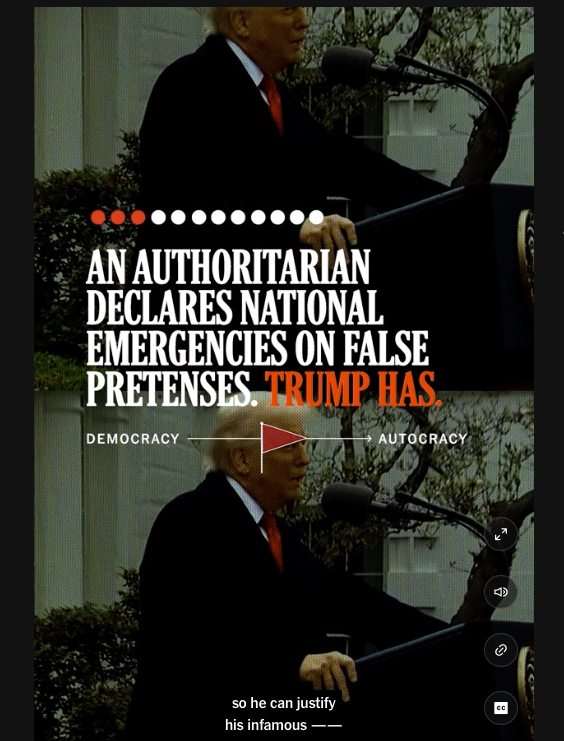
Are We Losing Our Democracy? - The New York Times
The views expressed in the excerpted New York Times Editorial Board opinion below are solely those of its authors. They do not reflect the views, positions, or policy recommendations of the Institute for the Study of States of Exception (ISSE), which does not take institutional positions on editorial commentary. The material is presented to illustrate a perspective relevant to ongoing debates concerning emergency powers and governance.
When you hear the word “autocracy,” the United States is rarely a country that comes to peoples’ minds. Right? Well according to these twelve red flags of democratic erosion, America has moved in the direction of autocracy, thanks to the efforts of President Donald Trump. The third red flag of democratic erosion, depicted in the linked video, is declaring national emergencies on false pretenses, which the New York Times Editorial Board indicates has already taken place since President Trump was inaugurated in early 2025.

Using and abusing statutory emergency powers: Elizabeth Goitein - Chautauqua Institution
First aired on July 11, 2024, following her remarks at the Chautauqua Institution, Elizabeth Goitein here explores the historical use and abuse of statutory emergency powers by U.S. presidents, emphasizing their infrequent invocation and the ethical implications, particularly highlighted by President Trump's controversial declaration during his first term for border wall funding. Goitein underscores bipartisan efforts for reform following these events, including proposed legislation to restrict the duration of emergency declarations. Goitein cautions against using emergency powers for long-standing issues like climate change, emphasizing their intended temporary and crisis-oriented nature in constitutional governance.

Declaration of a crime emergency in the District of Columbia
On December 4, 2025, the three judge U.S. Court of Appeals for the District of Columbia Circuit granted the Trump Administrations’s request to halt a lower court judge’s November 20, 2025, order concluding that President Trump’s deployment of 2000 National Guard troops to Washington, D.C., was illegal. The November 20 order had been postponed by the lower court’s judge from coming into effect until December 11, 2025, in order to give the Trump Administration time to appeal the decision. Initially, the D.C. attorney general had filed suit in September over the deployment, following President Trump’s August announcement that he would take over the city’s police department in conjunction with the National Guard deployments. As a result of the December 4, 2025, ruling, this suit filed by the D.C. attorney general will now continue.
The Indian Emergency (1975-1977) in Historical Perspective - from the book When Democracy Breaks
Democracy and authoritarianism have been historically bound in a complex and sometimes intimate relationship. The global emergence of quite a few democratically elected authoritarian leaders today has made explicit what had always been an underlying feature of the history of democratic practice. The authoritarian strain was perhaps more marked in countries aspiring to democracy by shedding an inheritance of colonial despotism. India’s experiment with democracy after winning independence from British rule offers a fascinating case study of the struggle to establish democratic norms amid the lure of falling back on the structures of an authoritarian legacy.

ISSE comments on Former JAGs Working Group statement on September 2, 2025 lethal strikes
On November 29, 2025, the Former JAGs Working Group issued a statement concerning the lethal strikes taken by the US Military on September 2, 2025, against a civilian boat allegedly carrying narcotics. The statement, which is linked here, is unequivocal in its conclusion that if the second strike, which targeted two survivors of the initial strike, occurred as was reported by both the Washington Post and CNN, then the giving and execution of the order to kill the survivors constituted a war crime, murder, or both.
From the point of view of ISSE, the September 2 strike that reportedly killed eleven civilians, and subsequent strikes against civilian boats that are reported to have killed over seventy additional civilians, are connected to, and logically flow from, the administration's use of emergency powers.

Blood Work podcast - “Crock of Schmitt”
Carl Schmitt was a German jurist, political theorist, and author known for his controversial association with the Nazi regime. He is influential in political thought for his concepts, particularly the idea that the sovereign is "one who decides on the exception" and that politics is defined by the “friend-enemy” distinction. His work was highly critical of liberal democracy and influential in the development of authoritarian political theory, and is for the most part unavoidable when discussing theory around states of exception.
The new Blood Work podcast series takes on Schmitt’s work in this November 19, 2025, episode entitled “Crock of Schmitt.”