

All Content
Welcome to the Institute for the Study of States of Exception (ISSE) main content page, a single source for all posts from the Institute, including commentary on global events, book reviews, academic literature, links to our podcasts, and additional resources. Check back regularly for more content from us.
“Sovereign is he who decides the exception.”
— Carl Schmitt (Political Theology: Four Chapters on the Concept of Sovereignty, 1922)

Short-term Security or Long-term Democratic Stability? Evidence from Ecuador’s war on gangs
Are citizens willing to trade long-term democratic stability for short-term security? We explore this question in Ecuador, where the powers of the executive and military have recently expanded in response to a dramatic rise in violent organized crime. Ahead of a national referendum proposing the expansion of these powers, we conducted a nationwide survey experiment. We find that informing citizens about the democratic risks of militarization — such as erosion of the rule of law or a heightened risk of an executive coup — significantly reduces support for a militarized approach to public security. This effect holds even when respondents are told that militarization may reduce violence. Our findings suggest that awareness of the potential democratic costs of widely used enforcement strategies, such as the militarization of security, could help prevent democratic backsliding in the face of heightened crime and violence…

Partisan Emergencies
Executive emergency powers are tantalizingly effective. They allow presidents to bypass congressional gridlock, do away with procedural safeguards, and act decisively with minimal oversight. But there is a risk that these exceptional powers may become a norm of domestic governance. This Note theorizes a problem of “partisan emergencies,” declared by a president despite significant disagreement about the factual existence of an emergency. One example is President Trump’s declaration of an emergency after Congress refused to fund his border wall. Other examples stem from Democrats calling on President Biden to declare an emergency to address issues like climate change and reproductive health. Congress, initially relying on a legislative veto to terminate such declarations, must now muster a supermajority if it disagrees with them. At the heart of the scheme is the National Emergencies Act, outlining how a president can declare a “national emergency” and what powers he unlocks by doing so without imposing a definition of the term. This Note surveys the judiciary’s recent treatment of emergency powers, positing that while courts are willing to engage in means-ends review about how an executive uses emergency powers, they are not willing to engage in the factual question of whether an emergency exists at all. This Note then argues that the judiciary must be willing to engage with this question to effectively rein in dubious invocations of emergency power…

Right to Seek Asylum in Emergency Contexts: The Regression of Hungarian Legislation (Diritto di asilo nei contesti di emergenza: l’involuzione della normativa ungherese)
This article analyzes the effectiveness of the right to seek asylum in the Hungarian legal system in the most recent emergency contexts. First, the legislative changes adopted following the so-called “migration crisis of 2015” are outlined, whereby the aim was to prevent access to the right to asylum. The measures introduced during the Covid-19 pandemic followed such a restrictive path. The article also assesses the conformity of the new measures with European and international law. To conclude, the armed conflict in Ukraine led to the coexistence of multiple emergency regimes, in which there is little room left to the effective exercise of the right to seek asylum…

Biden v. Nebraska (2023) - Major Questions Doctrine & Student Loan Forgiveness
This video lecture for Professor Dru Stevenson’s Administrative Law course (and Statutory Interpretation-Legislation) discusses the evolving Major Questions Doctrine and how it was applied and explained in Biden v. Nebraska, 143 S.Ct. 2355 (2023), in which the U.S. Supreme Court invalidated the President's original student loan forgiveness program, which had relied on the HEROES Act of 2003, which allowed the Secretary of Education to “waive or modify” student loan provisions during a national emergency. The Court’s holding was that this emergency-related authority did not extend to cancelling hundreds of billions in student loan principal…

States of Emergencies: Part I
The fight against COVID-19 has led many countries, including liberal democracies, to take extraordinary measures that would undoubtedly be constitutionally problematic in normal times. Around the world, we have witnessed entire countries being locked-down, with mass surveillance of cellphones, suspended religious services, restricted travel, and military-enforced curfews. While these measures are widely supported by the publics in many countries, some scholars and activists have raised the alarm that these might lead to a deterioration of civil liberties and constitutional democracy long-term. Specifically, they worry that many leaders might not easily give up their newfound powers, and that civil liberty restrictions will become a new normal.
While it is of course too soon to explore the long-term consequences of COVID-19 for constitutional democracy, we believe that it is helpful to understand the legal bases for the extraordinary powers that governments are currently exercising. In this brief Essay, we find that, while the details of course vary from country to country, there are three broad legal bases for the COVID-19 measures: (1) the declaration of a state of emergency under the constitution, (2) the use of existing legislation dealing with public health or national disasters, and (3) the passing of new emergency legislation. In the remainder of this Essay, we describe these three broad approaches. In a follow-up Essay, we will evaluate their respective risks to civil liberties and the rule of law…

States of Emergencies: Part II
In States of Emergencies: Part I, the authors described how the legal bases for countries’ coronavirus responses typically fall into three broad categories. First, some countries have declared a state of emergency under their constitutions, which allow them to take special measures, including restrictions of civil liberties, for the duration of the emergency. Second, some countries have relied on existing legislation relating to communicable diseases, health, and/or national disasters and used these laws as the basis for their COVID-19 response. Third, some countries have (also) passed brand new legislation that grant the governments new powers to respond to COVID-19.
When governments are granted powers to restrict rights, there is always a risk of abuse. To minimize these risks, three broad principles are important: (1) providing for legislative and judicial oversight of the executive, (2) limiting exceptional measures to those strictly necessary, and (3) ensuring that such powers endure only for the duration of the outbreak…

The Supreme Court’s Contribution to the Confrontation Over Emergency Powers - Lawfare
Three significant questions behind President Trump’s declaration of a national emergency during his first term to build a border wall have a single, surprising answer: Why did Congress in the National Emergencies Act (NEA) of 1976 delegate such broad and vague power to the president to declare national emergencies? Why wasn’t Congress more specific in defining the circumstances that constitute a national emergency? And why are the courts now going to have the final word in determining whether the president has properly invoked or abused the power the NEA gives him?
The answer to all these questions lies in a 1983 Supreme Court decision, INS v. Chadha. That decision, rightly or wrongly, decimated the policy scheme Congress had created for overseeing the president’s declaration of emergency powers—and nearly 200 other federal statutes in which Congress since the 1930s had created a similar scheme…

The genesis of the ‘Exceptional’ Republic: the permanency of the political crisis and the constitution of legal emergency power in Turkey
Almost half of the political life has been experienced under the state of emergency and state of siege policies in the Turkish Republic. In spite of such a striking number and continuity in the deployment of legal emergency powers, there are just a few legal and political studies examining the reasons for such permanency in governing practices. To fill this gap, this paper aims to discuss one of the most important sources of the ‘permanent’ political crisis in the country: the historical evolution of legal emergency power. In order to highlight how these policies have intensified the highly fragile citizenship regime by weakening the separation of power, repressing the use of political rights and increasing the discretionary power of both the executive and judiciary authorities, the paper sheds light on the emergence and production of a specific form of legality based on the idea of emergency and the principle of executive prerogative…

Rethinking the Federal Emergency Powers Regime
Emergency has assumed central importance in the United States legal system. In 2019, President Trump declared an emergency at the southern border after Congress declined to fund his wall; critics responded with legal challenges and proposed reforms to the statute he invoked, the National Emergencies Act (NEA). Emergency powers have also played a key role during the COVID-19 pandemic. This Article conducts a comprehensive survey of emergency powers in the United States. It shows that the NEA is only one among many grants of authority presidents can call upon in a crisis, alongside other emergency schemes, specially delegated statutory power, nonemergency statutes, and inherent executive authority. It argues that the United States' fragmented emergency powers scheme raises not only well-known risks of overreach presidents abusing emergency authority to gain power or erode democracy, but also less appreciated risks of underreach where presidents are unwilling or unable to deal adequately with a crisis…

Normative Evaluation of Presidential Powers in Emergency Situations: Constitutional Limits and Legal Guarantees in Indonesia
This study examines the exercise of presidential powers in emergency situations within the framework of Indonesia’s 1945 Constitution, focusing on constitutional limits and legal guarantees. Using a qualitative approach with a normative juridical methodology, the research analyzes constitutional provisions, statutory regulations, and judicial practices to evaluate the effectiveness of Indonesia's legal framework in balancing crisis management with the preservation of democratic principles. The findings reveal ambiguities in emergency criteria, gaps in accountability mechanisms, and concerns over proportionality in restricting fundamental rights. Comparative insights and recommendations are provided to enhance legal clarity, strengthen oversight, and safeguard constitutional democracy during emergencies…
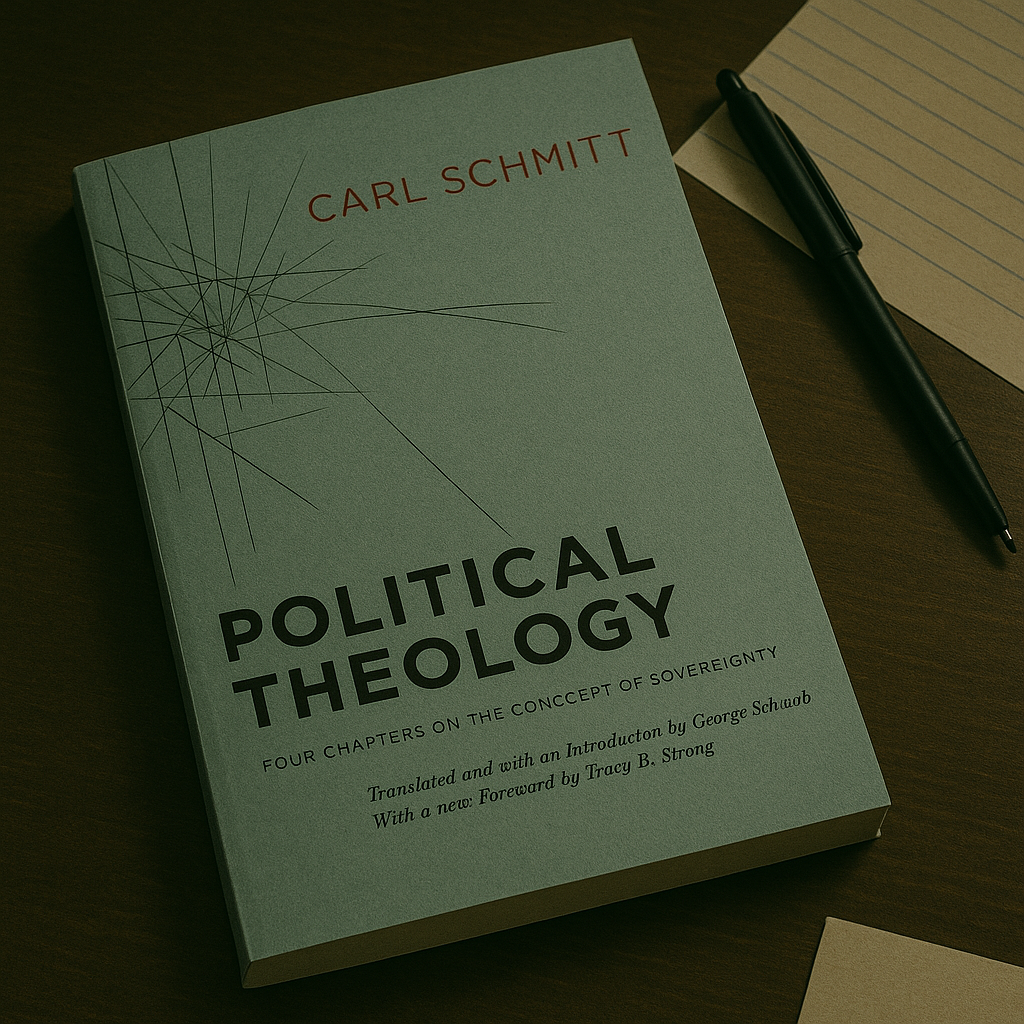
Political Theology
Carl Schmitt’s influential treatise, Political Theology (1922), represents a seminal and provocative contribution to political theory, particularly in its exploration of sovereignty, law, and states of exception. It remains a pivotal, yet contentious work for understanding the mechanics of sovereign power and the legal foundations of states of exception. Schmitt's central thesis, that the sovereign is defined primarily by the authority to decide upon exceptions or extraordinary circumstances, recasts traditional understandings of political legitimacy and authority…

A Guide to Emergency Powers and their Use - Brennan Center for Justice
In February 2019, President Donald Trump declared a national emergency to secure funding that Congress had expressly denied for the construction of a wall along the southern border. Before that declaration, most Americans were unaware that a vast set of laws gives the president greatly enhanced powers during emergencies. The Brennan Center, building on previous search, has (as of July 2025) identified 137 statutory powers that may become available to the president when he declares a national emergency, including the power President Trump invoked to help build the wall (10 U.S.C. 2808 (a)). An additional 13 statutory powers become available when a national emergency is declared by Congress…

State of Exception
Giorgio Agamben’s State of Exception (2005) is among the most influential texts in contemporary political philosophy addressing the implications of emergency powers and their relationship to democratic governance. Agamben not only builds upon but fundamentally reconfigures Carl Schmitt's seminal theory of sovereignty, meticulously unpacking what he identifies as the central paradox facing modern states: how democratic governments suspend the law purportedly in its defense. For Agamben, the state of exception represents a "zone of indistinction" where the boundaries between law and lawlessness, democracy and authoritarianism, become dangerously blurred…

A Spatial Theory of the Camp: Geopolitics, Biopolitics and the Immunitarian State
From concentration camps to refugee settlements, there is little consensus about what exactly defines ‘the camp’. This timely and comprehensive book adopts a geographical perspective to develop a spatial theory of the camp, advancing the interdisciplinary field of camp studies. Richard Carter-White and Claudio Minca explore the spatial logics and practices that unite different camps, demonstrating why the camp has become such an integral tool of contemporary governance and what this reveals about the geopolitics and biopolitics of the modern nation-state…

Judicial Review in Times of Emergency: From the Founding through the COVID-19 Pandemic
In the immediate wake of the assassination of President Abraham Lincoln and just ten days after newly sworn-in President Andrew Johnson issued an order calling for a military trial of the alleged conspirators in Lincoln’s killing, the government brought the accused before a tribunal composed of nine military officers at the Old Arsenal Penitentiary in Washington, D.C. The President’s order empowered the commission to set its own rules of procedure. By the ensuing rules, a majority vote of the officers could sustain a guilty verdict, a two-thirds majority vote could sustain a death sentence, and the only avenue for appeal was to seek a pardon from the President…

Executives in Crisis: An Examination of Formal and Informal Emergency Powers
This Article examines the ways in which various constitutional structures grant and constrain emergency powers. Specifically, the Article examines how a country defines the emergency powers of its chief executive and whether that definition is formal or informal. The Article also explores what effect the distinction between formal and informal powers has on a constitutional system’s ability to prevent a devolution of constitutional norms. The Article undertakes this inquiry by examining the use of emergency powers in different countries and at different times. It examines the constitutions of Germany’s Weimar Republic, Charles de Gaulle’s Fifth French Republic, and Indira Gandhi’s rule in India, as well as specific examples from United States history…

Crisis as Governance: How Emergency Became the Default Condition - The Deeper Thinking Podcast
We used to treat crisis as the exception. Today, it is the rule. This episode investigates how emergency governance became a permanent operating mode—reshaping democracy, law, and freedom. Governments no longer return to normal. They have learned to govern through disruption.
Drawing on Giorgio Agamben, Michel Foucault, Naomi Klein, and Edward Snowden, we trace the transformation of power across terrorism, pandemics, and economic collapse. What emerges is a deeply revealing pattern: emergency as the default strategy of control…

Giorgio Agamben: Homo Sacer and State of Exception
At the edge of law and life, Giorgio Agamben highlights a hidden paradigm of power and exclusion. A paradigm found in ancient Rome that still makes its mark on modern society. Is the rule law, or is exceptions to the law, the rule? Is modern democracy rooted in its definition? Agamben leaves us with interesting answers that may inform the future.

The Lawfare Podcast Bonus Edition: Steve Vladeck on Emergency Powers and Coronavirus
What can the president do in a national emergency? What limits what the president can do? What authorizes the president to do all those things he can do in a national emergency? Is the president abusing, misusing, using appropriately, or under-using emergency powers during the coronavirus crisis? And what are the logical end points for how far this could go? For this bonus edition, Benjamin Wittes got on the phone with Steve Vladeck to work through these questions and talk about all things presidential emergency powers.

Taking Exception to States of Exception
In this episode from the Center for Strategic and International Studies’ podcast series “35 West,” Christopher Hernandez-Roy sits down with Steven Dudley, Co-Director of InSight Crime and author of the award-winning book MS-13: The Making of America’s Most Notorious Gang. Together, they unpack the nature of El Salvador's state of exception, what differentiates it from past hardline policies, and the threat this "Plan Bukele" poses to El Salvador and to democracies throughout the region. They also delve into the impact of both gang violence and counter-gang repression on Salvadoran citizens, and what can be done to promote lasting security in Central America.