
The Legal Anatomy of the Body: Health, Rights, and Politics in Times
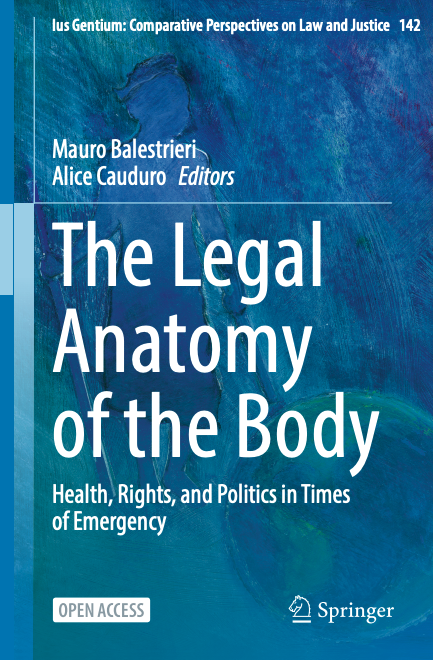
The Legal Anatomy of the Body: Health, Rights, and Politics in Times
Editors: Mauro Balestrieri and Alice Cauduro. Balestrieri is an Associate Professor of Comparative Law, University of Turin. Cauduro is an Assistant Professor of Administrative Law, University of Turin.
Book Publisher: Springer Cham
Date of Publication: June 2026
Book Citation: Balestrieri, M; Cauduro, A. (2026) The Legal Anatomy of the Body: Health, Rights, and Politics in Times of Emergency, Springer Cham. https://doi.org/10.1007/978-3-032-26434-3
The Legal Anatomy of the Body: Health, Rights, and Politics in Times of Emergency can be purchased as a hardcopy book here, and is also available open access as a PDF here.
The Legal Anatomy of the Body: Health, Rights, and Politics in Times of Emergency is part of the book series: Ius Gentium: Comparative Perspectives on Law and Justice. Ius Gentium is a book series which discusses the central questions of law and justice from a comparative perspective. The books in this series collect the contrasting and overlapping perspectives of lawyers, judges, philosophers and scholars of law from the world's many different jurisdictions for the purposes of comparison, harmonisation, and the progressive development of law and legal institutions.
About this book: The Legal Anatomy of the Body: Health, Rights, and Politics in Times of Emergency brings together an interdisciplinary collection of scholars examining how law, public health, technology, and political authority increasingly converge in the governance of contemporary societies. Framed around the concept of emergency, the volume explores how states of exception shape the regulation of bodies, healthcare, surveillance, digital technologies, and fundamental rights, while tracing the historical and philosophical development of these ideas from early modern public health through the COVID-19 pandemic and beyond. Combining perspectives from law, political theory, philosophy, sociology, medicine, and science and technology studies, the collection argues that health has become one of the principal domains through which exceptional governance is exercised, raising important questions about constitutionalism, democracy, privacy, digital surveillance, and the future of public authority.
Why ISSE Is Recommending This Book: This volume addresses one of the most significant developments in the contemporary study of states of exception: the expansion of emergency governance beyond traditional questions of war and national security into the domains of public health, digital infrastructure, surveillance, and the regulation of everyday life. Rather than treating emergency powers as temporary responses to extraordinary events, the contributors examine how preparedness, medical governance, and technological systems increasingly become embedded within ordinary legal and administrative structures. Although the volume reflects a range of theoretical perspectives (including work influenced by Michel Foucault and Giorgio Agamben) it offers an important interdisciplinary contribution to understanding how exceptional powers evolve, how they reshape the relationship between the state and the individual, and how constitutional democracies confront the challenge of preserving fundamental rights while responding to increasingly complex and persistent emergencies. As such, it provides valuable context for many of the emerging issues at the center of ISSE's research agenda.
